No. Plenty of Leeds terraces still have an old fuse box with rewireable fuses in the cellar, and an old board isn’t automatically unsatisfactory.
What the inspector codes
The inspector codes what they actually find: how the circuits are protected, whether earthing and bonding are in place, and whether anything is damaged.
Old rewireable fuses and no RCD on the lighting is often coded C3, which on its own doesn’t fail the report.
Sockets that could power equipment outdoors without RCD protection are often coded C2.
Unlabelled circuits make faults harder to isolate. We note it as an improvement, and a label chart costs almost nothing to add.
The colour dots
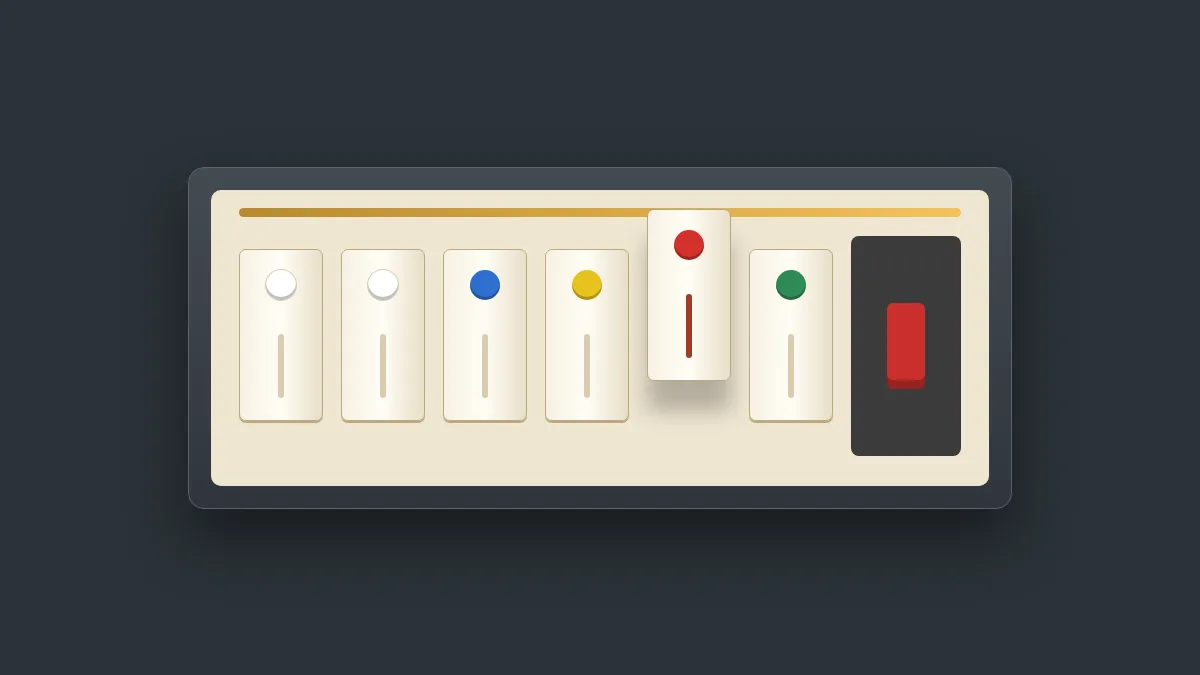
The colour dots on an old fuse carrier show its rating: white 5A, blue 15A, yellow 20A, red 30A and green 45A.
Pull a fuse on the interactive fuse board on our home page to see typical findings and how they would be coded.
In a lot of Leeds terraces the meter and consumer unit are at the bottom of the cellar steps. A little preparation makes the visit quicker for everyone.
Before we arrive
Clear the cellar steps and the board. Boxes, bikes and paint tins usually end up stacked against the consumer unit.
Tell the tenants the power goes off. Short spells only, but fridges, Wi-Fi and gaming PCs will notice.
Keys for every room. Locked bedrooms, the attic room, outhouses in the yard, garages and meter cupboards.
Find the last report. An old EICR or an installation certificate from a rewire helps the inspector compare results.
Flag anything that can’t go off. Medical equipment, alarm panels, fish tanks or a home server. We’ll plan around them.
Mention parking. Resident permit zones around Headingley, Hyde Park and the city centre are easier with a heads-up.
Note any extensions or outbuildings. Kitchen extensions, cellar conversions and garden-room supplies all get tested.
On the day
A visual check comes first, then dead tests with the power off for short spells, then live tests, including RCD trip times. We tell the tenants before anything goes off, and the PDF report reaches you within 48 hours of the visit.
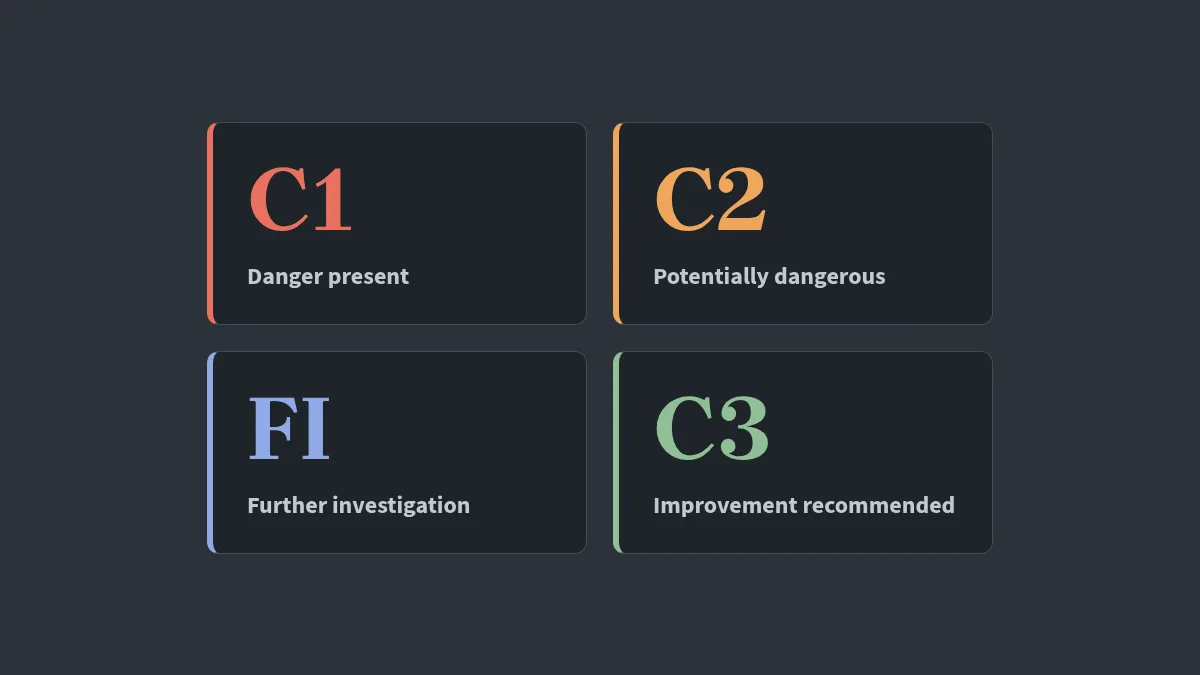
An inspector codes every observation on the report. The code tells you how serious it is and what has to happen next.
Quick answer
C1, C2 and FI each make an EICR unsatisfactory. C3 on its own doesn’t. In a rented home in England, anything coded C1, C2 or FI has to be fixed or investigated within 28 days, or sooner if the report says so.
The four codes at a glance
Code
What it means
The report
What has to happen
C1
Danger present. Risk of injury.
Unsatisfactory
Usually made safe before the inspector leaves, then repaired
C2
Potentially dangerous
Unsatisfactory
Fixed within 28 days, or sooner if the report says so
Unsatisfactory. Made safe on the spot, usually by isolating it, and you’re told the same day. The repair is confirmed in writing to the tenant and the council within 28 days.
C2: potentially dangerous
Unsatisfactory. Must be fixed within 28 days, or sooner if the report says so, then confirmed in writing to the tenant and the council. Missing main bonding to the gas pipe where it comes into the cellar is one of the most common C2s in older Leeds terraces.
FI: further investigation
Unsatisfactory until it’s resolved. Investigate without delay, then fix anything found.
An FI means the inspector found something they couldn’t settle on the day. The investigation is part of the remedial work, so the same 28 days apply.
C3: improvement recommended
The report can still be satisfactory. Worth doing at the next refurbishment.
You don’t have to make a C3 improvement, but it’s a useful list to work from when you next have an electrician in.
If the report is unsatisfactory
Any C1, C2 or FI has to be fixed or investigated within 28 days, or sooner if the report says so. We give you an itemised quote, and you can use any qualified electrician.
Get the remedial work and any further investigation done within 28 days, or sooner if the report gives a shorter deadline.
Ask whoever did the work for written confirmation. A satisfactory EICR, an Electrical Installation Certificate or a Minor Electrical Installation Works Certificate all count.
Send the report and that confirmation to your tenant and to the council within 28 days of the work being finished.
Keep the report until the next inspection, and give the next inspector a copy.
No. A C3 is a recommendation. A report with only C3s can still be satisfactory.
Do I need a whole new EICR after the repairs?
Not always. The written confirmation can be a satisfactory EICR, an Electrical Installation Certificate or a Minor Electrical Installation Works Certificate, depending on the work that was done.
Can a different electrician do the remedial work?
Yes. You can use any qualified electrician. The confirmation comes from whoever carried out the work.
Leeds kept building back-to-backs until 1937, long after other cities had stopped. A council housing paper puts the surviving number at around 19,500, most of them privately rented and built before 1919. You find them in rows across Harehills, Beeston, Holbeck, Burley, Hyde Park and Armley.
Two homes, one wall, two reports
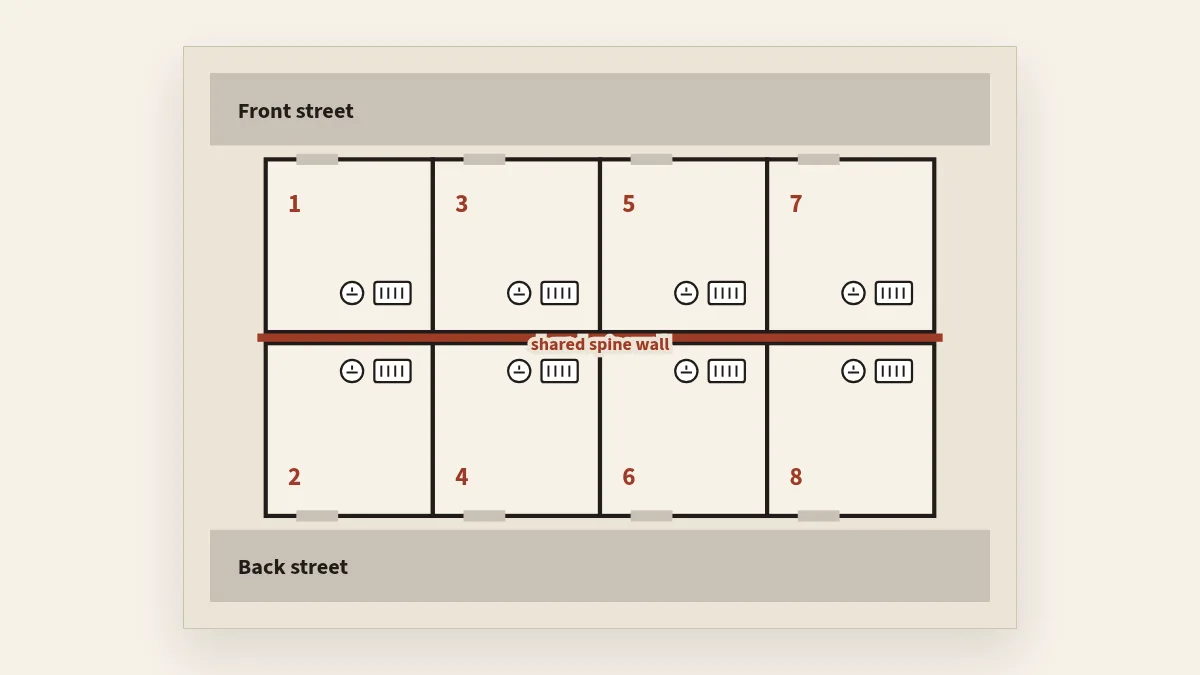
Each back-to-back is a separate home with its own meter and its own consumer unit, usually at the cellar head or down in the cellar. So the house that shares your back wall needs its own report.
The same holds when a through-terrace or a big Headingley villa has been split into flats: one report per flat.
Don’t forget the landlord supply
In a converted house the hall and stair lights often run from a separate landlord supply. Tell us when you book and we’ll include it in the fixed price.
What we often find in back-to-backs
Consumer unit at the cellar head or in the cellar
Attic bedroom circuits added later, sometimes without earthed fittings
Damp cellars: corroded boxes and cable clips
Older boards without RCD protection
A visit usually takes about 1.5 to 2.5 hours. A 1–3 bed is £118.99, and one with an attic bedroom as a fourth bedroom is £129.99, fixed in writing before we book.